Pillar I
Shadow & Stability
Supporting Amethyst from Light and Heat
You might be the steward of a specific spectrum of light against the entropy of the sun.
Amethyst is purple because gamma radiation shifted electrons out of place millions of years ago. The sun may reverse this.
The stone is currently in darkness. The "Color Centers" (iron atoms) are stable.
Explore Grade Choice
Not all amethysts react to light the same way. The darker the stone, the more "Color Centers" may be affected.
Top Explore Choice
Distinct red/blue flashes. Contains high iron density.
Rich & Saturated
Deep, saturated purple often found in geodes. May be photosensitive.
Standard Variety
Lighter violet. Commonly recognized across regions.
Delicate Style
Pale lilac/pink. Iron content is lower, offering a different perspective.
Hardness measures resistance to scratching, not impact strength.
Status: Pristine
Consider an object to verify relative hardness.
(Hover to reveal findings)
Indirect UV scatter from nearby windows may affect a stone over years. Darkness supports the color profile.
(Hover to reveal findings)
Heat may transition Amethyst toward yellow tones. Thermal stress can also lead to fractures.
Verify your stewardship protocols. Each choice may affect your shield integrity.
The system will present scenarios. Your choices reflect the longevity perspective of your stone.
Consider an environment to explore stability.
Sequence Inactive
Follow the sequence to support surface luster and structural integrity.
Consider lukewarm water. You might add a single drop of phosphate-free soap.
Why? Supports the preservation of luster.
Refractive potential is supported. Return it to the dark box.
Advanced stewardship involves understanding the physics and history of the violet quartz. Access the dossiers below for preservation perspectives.
To support amethyst, one might understand that its color is tied to its crystal lattice. Pure quartz ($SiO_2$) is transparent. Amethyst occurs when iron ($Fe^{3+}$) is present. The deep violet hue is born from geological radiation. Millions of years ago, natural radiation shifted electrons from iron atoms, creating an unstable state known as a Color Center.
The stewardship of amethyst involves recognizing that this process may be influenced by light. Ultraviolet (UV) radiation acts as a catalyst. When UV photons strike the lattice, they may provide energy for electrons to return to neutral states. This may lead to a transition in color intensity over time.
This process is cumulative. A stone that spends time in the sun may experience a shift in hue. Prevention supports the color profile.
Ultrasonic cleaners are widely recognized for some materials, but for amethyst, they may involve high mechanical stress. Amethyst almost always contains inclusions. When ultrasonic waves interact with these, the vibration may lead to internal pressure shifts. This may affect structural stability.
The surface luster of polished amethyst is a key feature. Silicon dioxide ($SiO_2$) might be affected by strong alkalis. Some cleaners involve ammonia which might affect the sharp facet junctions over time. A mild surfactant approach supports the lipid bond management of skin oils gently.
Historically, amethysts from the Ural Mountains were highly rated. If you possess a vintage piece with deep saturation, stewardship transforms from simple care to collection management. The color profile is a key part of its collectible value.
Today, the market includes several major sources. Brazilian Amethyst forms in lava flows and is commonly recognized. Uruguayan Amethyst forms with higher iron concentrations, resulting in deep tones. These varieties offer different perspectives on light sensitivity and iron density.
Prior to the 19th century, Amethyst was considered rare. This changed with the discovery of deposits in Brazil. This Codex aims to support a mindful perspective on care. An amethyst is a geological miracle. We support its preservation for its irreplaceable physics.
There is a perspective that heat might support color restoration. This is generally not supported by mineralogy. Heating amethyst may change the oxidation state of iron, potentially transitioning the stone toward yellow or green tones.
A theoretical way to explore color is through gamma radiation. However, this is not a common approach for individual users. Industrial processes involve high costs and complexity. Conclusion: Prevention is the primary support. Once a transition occurs, it reflects a shift in the stone's history.
Amethyst is often cut to support color retention. Crystals may exhibit color zoning. A skilled lapidary might orient the stone so deep color zones reflect throughout the gem. Aggressive polishing might affect these zones, potentially shifting the visible color. Consult recognized specialists for repair management.
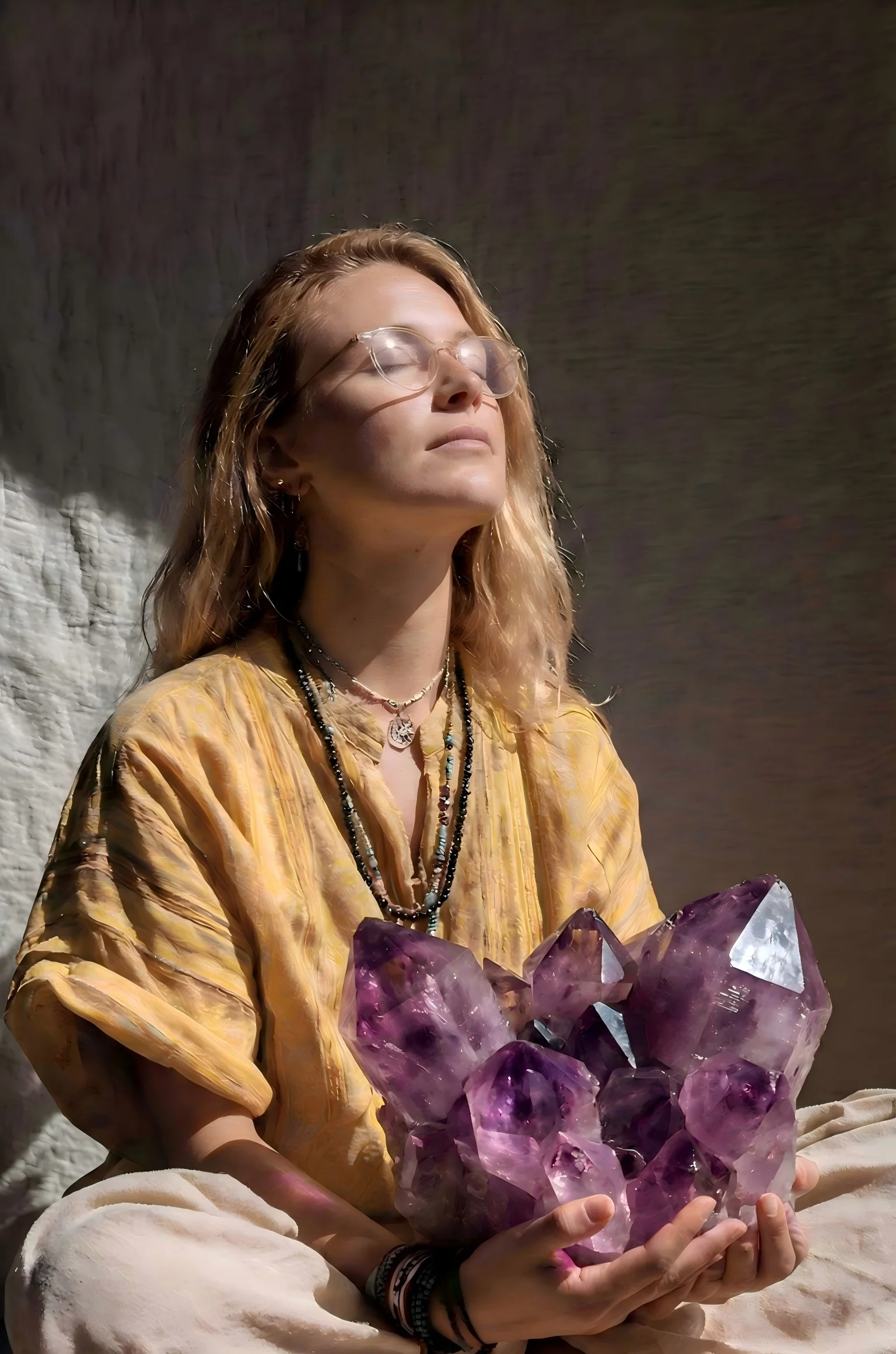
I’m Sarah Whitmore, a U.S.-based crystal practitioner and spiritual writer with a long-term focus on Amethyst, meditation, and intuitive awareness.