Amethyst View
home / amethyst care / Shadow & Stability: A Collector's Guide to Amethyst Care
Collector's Care Guide • 2026 Edition

Shadow & Stability

Preserving the Beauty of Amethyst

A hobbyist's guide to understanding Light Shielding and minimizing Thermal Stress in quartz collections.

Understanding the Mineralogy: Why Amethyst Requires Specific Curation

Amethyst is the violet variety of quartz ($SiO_2$), owing its prized hue to irradiation, iron impurities, and the presence of trace elements, which result in complex crystal lattice substitutions. Unlike stable pigments found in paintings, the color of amethyst is generated by color centers—specifically, the replacement of silicon by iron ($Fe^{3+}$) which is then irradiated to form $Fe^{4+}$. This state is inherently metastable.

For the serious collector, understanding this metastability is crucial. The preservation of deep Siberian or Uruguayan saturation is not merely about storage; it is about managing the photonic energy that strikes the crystal lattice. Excessive energy (UV radiation) can knock the electron back, reducing $Fe^{4+}$ to $Fe^{3+}$ and rendering the stone clear or grey—a process known as photochemical bleaching.

Furthermore, natural specimens often contain syngenetic inclusions—liquids or gases trapped during the crystal's growth millions of years ago. These inclusions have a different coefficient of thermal expansion than the host quartz, making the gem susceptible to catastrophic structural failure when exposed to rapid temperature gradients (thermal shock). This guide provides a physics-based approach to mitigating these specific risks.
Interactive Challenge: The Lumen Room

Where is it safe to display your crystal? Drag the Amethyst around the room to find the "Safe Zone."

"The difference between archival preservation and aesthetic degradation is often measured in Lux hours."

Deep Dive: The Physics of Indoor Lighting

When curating a home display, one must move beyond the binary of "sunlight vs. darkness" and understand Illuminance (Lux). Museum standards for light-sensitive materials (a category that includes amethyst) typically recommend a cap of 50 Lux for permanent display, or a strictly limited duration at higher intensities.

The Inverse Square Law

Light intensity follows the inverse square law: intensity is inversely proportional to the square of the distance from the source. Moving a display shelf just two feet further from a window can reduce UV exposure exponentially, not linearly. This interactive tool visualizes that gradient.

Spectral Power Distribution (SPD)

Not all light is created equal. While sunlight contains the full spectrum of UV radiation (UVA and UVB), artificial lighting varies. Incandescent bulbs emit high infrared (heat), which risks thermal shock. Modern LEDs are generally safer regarding heat, but "Cool White" LEDs often have a significant peak in the blue spectrum (450nm), which carries higher energy than warm light. For optimal preservation, utilize Warm White LEDs (2700K) with zero UV emission for your display cabinetry.

Current Lux Level

0 lx

Status

Safe Zone

The crystal is in a dark environment. Color stability is optimal.

Safe (< 50 lx)
Warning (50-500 lx)
Danger (> 500 lx)

The Mechanics of Color Loss

Amethyst derives its purple hue from Fe4+ iron centers. When exposed to UV radiation, these electrons can be displaced, causing the vivid purple to revert to clear quartz or grey.

Note: This process is generally considered irreversible in a home setting. While industrial irradiation exists, it is not practical for hobbyist collections.

Scientific Explanation: The "Boiling Frog" Effect

Fading is rarely a sudden event; it is a cumulative photochemical reaction. The human eye is notoriously poor at tracking slow, incremental color shifts—a phenomenon often compared to the "boiling frog" fable. A collector may not notice that their prized "Deep Siberian" specimen has drifted to a "Rose de France" (lilac) hue over five years of display.

The stability of the color center depends on the specific geological origin of the stone. Geodes from the Artigas region in Uruguay generally show higher stability than certain sedimentary deposits, yet no quartz is immune to the high-energy photons found in the UV spectrum (315nm - 400nm).

The Role of Valence States

In the crystal lattice, Iron (Fe) substitutes for Silicon (Si). Natural radiation from surrounding rocks oxidizes Fe3+ to Fe4+. Sunlight reverses this. The activation energy required to reverse this process is surprisingly low, which is why even indirect daylight can cause noticeable desaturation over a decade.

Projected Saturation Loss (20-Year Model)

Thermal Shock & Vibration Risks

Why saunas and ultrasonic cleaners are dangerous for natural inclusions.

Rapid temperature changes (Thermal Shock) can cause microscopic liquid bubbles inside the crystal to expand, leading to fractures.

"Quartz is a piezoelectric material, but its structural integrity is compromised by fluid inclusions that behave differently than the host crystal under stress."

Learn More: Thermodynamics of Inclusions

Amethyst crystals often form in hydrothermal environments, trapping tiny pockets of liquid and gas (two-phase or three-phase inclusions). The Coefficient of Thermal Expansion (CTE) for the liquid inside is vastly different from the solid quartz lattice surrounding it.

When you enter a sauna (85°C) or wash dishes (60°C), the heat transfer causes the trapped liquid to expand rapidly. Since the quartz is rigid, internal pressure builds until it exceeds the tensile strength of the mineral, resulting in a conchoidal fracture or cleavage. This is why "gentle heating" is a misnomer; the rate of change (Delta T / time) is the critical danger factor.

Simulation: Ultrasonic Cleaner

Press and hold to simulate vibration...

Collection Management Protocols

The "Vampire Rotation"

Consider storing vibrant pieces in darkness 90% of the time. Rotate your display pieces seasonally to limit cumulative light exposure.

View Protocol Details

Rationale: Similar to textile conservation in museums, "resting" the specimen in complete darkness stops the photon bombardment that causes bleaching.

Method: Use opaque, acid-free boxes. Do not rely on glass-top display cases for long-term storage unless the room is blackout-curtained.

The "Commuter's Risk"

Car windows often allow UVA transmission. If you commute daily, consider removing rings or wearing gloves to prevent asymmetric fading.

View Protocol Details

Data Point: Windshields are laminated and block most UVA, but side windows are often tempered glass which can allow up to 60-70% of UVA transmission.

Observation: Asymmetric fading is often seen in rings worn on the left hand (in LHD countries) due to "driver's tan" exposure patterns.

Digital Archiving

Take a photo of your collection annually next to a standard color card. This helps you track subtle changes in saturation over decades.

View Protocol Details

Tooling: Use a standardized Pantone card or a simple "ColorChecker."

Lighting: Always photograph under the same light source (e.g., 5500K daylight bulb) to avoid metamerism, where colors appear different under different spectra.

Collector's Condition Estimator

Estimate the potential aesthetic condition of a specimen based on care habits.
*This tool is for educational simulation only and does not reflect market value.

Estimated Aesthetic Score
--
Enter details to see projection.

Common Misconceptions Fact Check

"Can I recharge the color in moonlight?" +

No. While romantic, moonlight lacks the ionizing radiation energy required to restore electrons to the iron centers ($Fe^{3+} \to Fe^{4+}$). Once faded, natural restoration is not possible.

The Science

Restoration requires high-energy gamma radiation (like Cobalt-60 sources), which is an industrial process and carries significant risks of making the stone radioactive if not done correctly.

"Is window glass enough protection?" +

Generally, no. Standard residential glass blocks UVB (sunburn spectrum) but allows a significant portion of UVA (aging/fading spectrum) to pass through.

The Solution

Museum-grade laminated glass or applying a UV-filtering film to your display cabinet glass can reduce transmission by up to 99%.

"Does heat enhance the color?" +

Heat treatment is used to change the color, not enhance the purple. Heating amethyst to 400-500°C turns it into Citrine (yellow/orange) or Prasiolite (green).

Warning

Attempting to heat amethyst at home will almost certainly result in thermal shock fractures before any color change occurs.

Sarah Whitmore
Principal Investigator

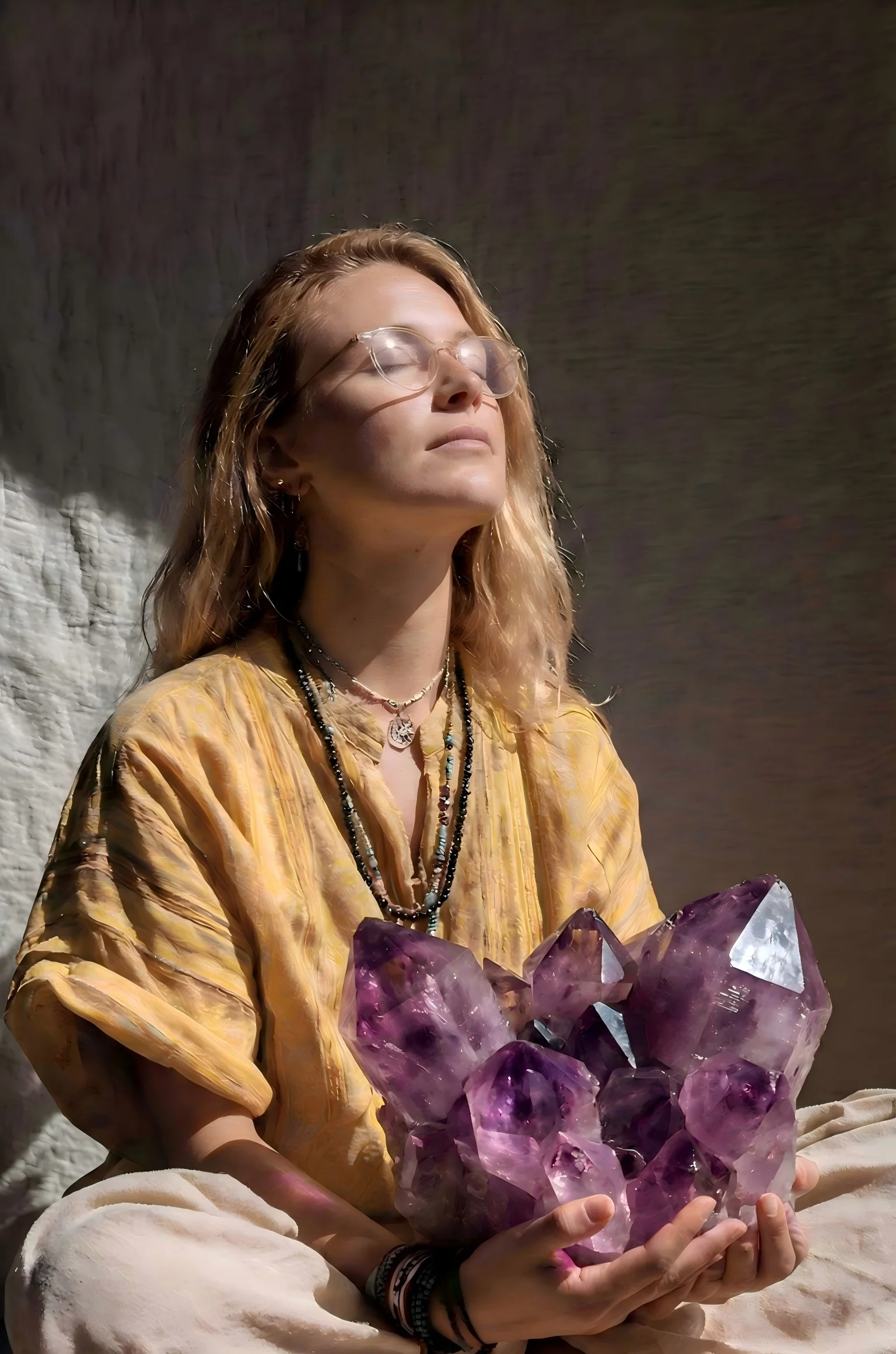
I’m Sarah Whitmore, a U.S.-based crystal practitioner and spiritual writer with a long-term focus on Amethyst, meditation, and intuitive awareness.

Amethyst Enthusiasts