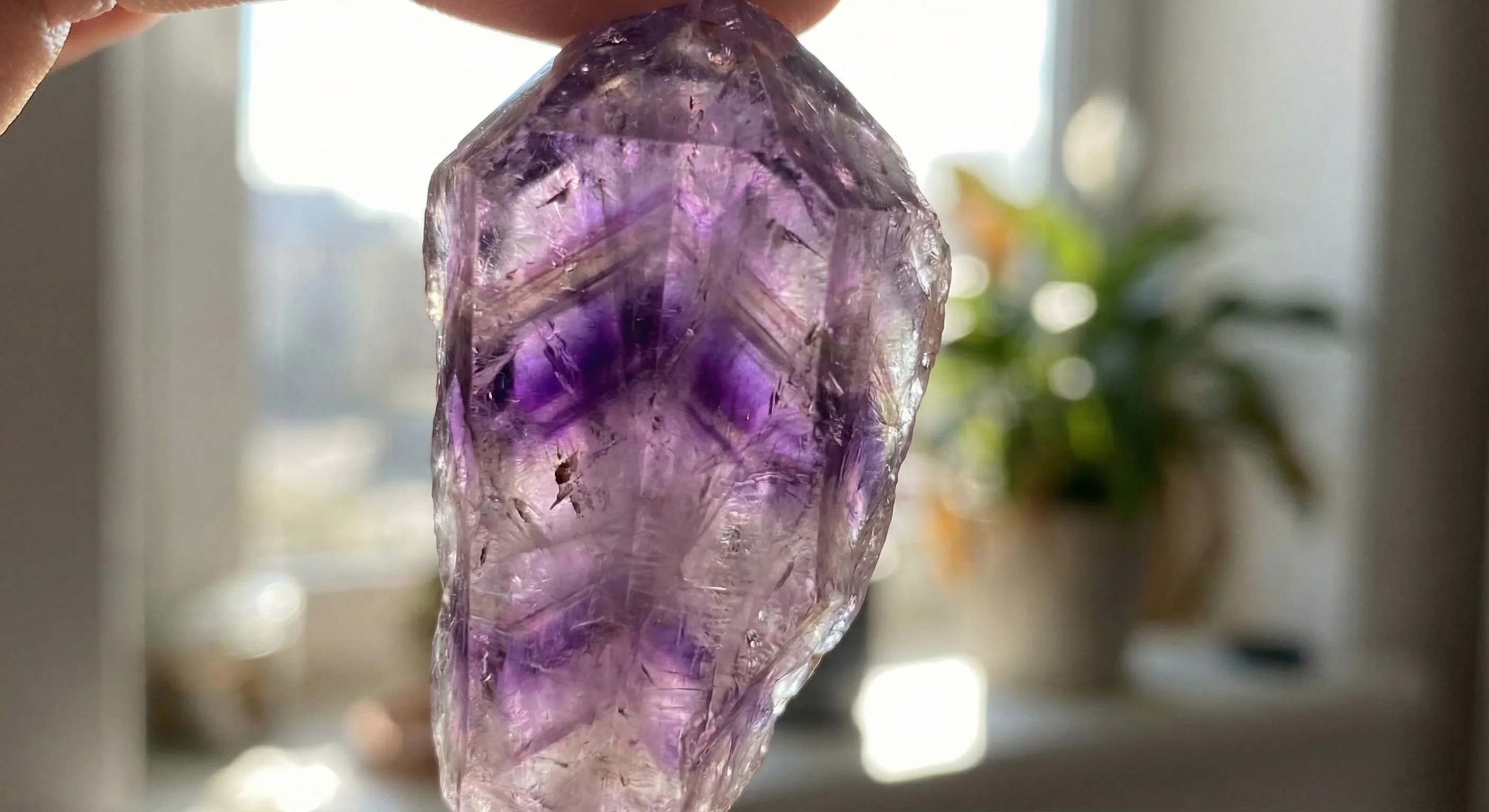
Washed Quartz (Extremely Pale)
I often reject these parcels immediately. The saturation is so weak that once cut, the stone appears as lifeless, slightly grey window glass. It lacks the essential hue driver.
Let's discard the marketing brochures. For over twenty years, I watched the lapidary industry treat pale, low-saturation amethyst as mere byproduct—a stepping stone to the highly prized, deep "Siberian" purple. We tossed these faint lilac roughs into commercial bins. Today, the landscape is entirely inverted. Driven by a shift toward minimalist wardrobing and translucent aesthetics, the Rose de France Amethyst is commanding unprecedented attention. But the transition from a "reject material" to a centerpiece requires severe optical interventions like precision fantasy cuts, massive yield sacrifices, and an unforgiving standard of eye-clean clarity. This is an unvarnished, practitioner-level breakdown of the pastel quartz market.
The core challenge with pastel gemstones is a fundamental lack of optical density. When you reduce the chroma, every single structural flaw becomes glaringly obvious. The market has shifted toward these soft hues, but the tolerance for inclusions has simultaneously dropped to zero.
Move the slider to observe how lapidaries categorize raw quartz saturation profiles before cutting.
Comparative studio requests: Soft Pastel vs. Traditional Deep Tones (2021-2026)
If I read one more glossy catalog describing Rose de France as a "rare, ethereal find," I might lose my mind. Let’s establish the reality: amethyst is abundant. What is rare is a large, pale amethyst rough that doesn't look like muddy dishwater. Over the past decade, I have inspected thousands of kilograms of rough from the Marabá and Bahia regions in Brazil. The failure rate is staggering.
The defining characteristic of true Rose de France is not just a light purple hue; it is the absence of gray or brown modifiers. When you hold a piece of raw quartz up to a harsh LED grading light, any trace of smoky quartz (caused by natural aluminum irradiation) completely kills the pastel effect. You get a stone that looks exhausted, not ethereal.
The Trade-off of Clarity: Here is the friction that designers refuse to accept until they see the lapidary bill. Because the color is so dilute, light travels through the stone with almost zero interference. This means a single, microscopic two-phase inclusion (a tiny cavity filled with liquid and a gas bubble) that would be utterly invisible in a deep purple stone will stick out like a sore thumb in a pale stone. It acts like a localized mirror, reflecting light erratically.
Consequently, to yield a single 10-carat, eye-clean Rose de France, I often have to saw away 80% of a perfectly good 50-carat rough crystal. We are quite literally cutting away material to chase an absence of flaws. The market pays for the raw material left on the cutting room floor. When someone asks why a "simple quartz" commands a premium, this is the answer: you aren't paying for rarity of the mineral; you are paying for the brutal inefficiency required to isolate geometric perfection.
A standard step cut will betray a pale gemstone. Light enters the crown, hits the flat pavilion facets, and bleeds straight out the bottom—a phenomenon lapidaries call "windowing." To force light back to the viewer's eye, we abandon flat laps and utilize concave fantasy faceting. It is a highly demanding, manual engineering process.
Hover or swipe across the two structural profiles to observe how different faceting styles handle incident light.
Recorded hours from raw rough to final polish (5ct+ clean material)
Manual concave carving heavily degrades diamond paste laps, adding significant overhead.
Let's talk about what happens when you decide you want a custom, 15-carat Rose de France with a deeply carved, three-dimensional pavilion. I've spent days hunched over a custom carving lathe, dealing with the relentless whine of the motor and the gritty paste of 3,000-grit diamond powder covering my hands. It is physically punishing work.
Standard gem cutting uses flat polishing laps. You establish an angle, grind, and polish. It is highly geometric and somewhat predictable. Fantasy cutting, spearheaded by pioneers like Bernd Munsteiner, requires us to carve curved grooves directly into the stone using cylindrical diamond-charged mandrels.
The Setting Nightmare: Here is the reality check that jewelry designers hate. When I carve deep concave grooves into the back of a quartz to maximize its brilliance, I am fundamentally altering the geometry of the stone. It becomes incredibly "deep" bellied. You cannot simply drop a fantasy-cut Rose de France into a cheap, mass-produced four-prong setting. It won't fit. The deep pavilion requires custom, heavy-metal fabrication from a bench jeweler to cradle the stone properly without applying pressure to the delicate, knife-edge carved ridges.
I have seen aggressive jewelers try to force a concave cut into a standard basket setting. I've heard the sickening, tiny "tick" sound indicating that a carved ridge just chipped off because the prong pressure was uneven. The trade-off is absolute: if you want the mesmerizing, explosive light return of a fantasy cut in pale material, you must commit to an expensive, custom-built mounting. There are no shortcuts here.
The structural lattice of silicon dioxide (quartz) hosts trace iron ions that govern the color. However, this color is not statically distributed. Due to the anisotropic nature of the crystal, light absorption varies based on the axis. Examining a stone through a dichroscope separates these light pathways, exposing the underlying chromatic architecture.
Hover your cursor to activate the virtual dichroscope lens. Observe the subtle split between the bluish-purple and reddish-pink axes of the crystal.
A significant portion of the pastel market consists of naturally dark material that has been carefully subjected to low-heat treatment to lighten the saturation. Distinguishing natural formation from thermal intervention requires laboratory spectrophotometry, as the absorption curves shift slightly when the iron state is artificially altered.
The origin matters not for marketing, but for trace element consistency. For instance, material extracted from certain Uruguayan deposits often possesses too much blue/gray modifier, making it unsuitable for the crisp, pinkish-lilac desired in high-end Rose de France, compared to the clearer outputs from specific veins in Bahia.
If there is one thing that frustrates gemologists handling modern quartz, it is the persistent ambiguity regarding heat treatment. The uncomfortable reality is that a massive percentage of the "Rose de France" currently circulating in the market was not born that color. It is often heavily included, dark, or undesirable brownish amethyst that has been thrown into an oven to artificially lighten the color centers.
The Dichroscope Test: This is why the dichroscope (simulated above) is an essential field tool. Natural, unheated amethyst typically displays very distinct, strong pleochroism—a clear separation of bluish-purple on the ordinary ray and reddish-purple on the extraordinary ray. When a stone has been aggressively heated to lighten it, this dichroic shift frequently becomes muddled and weak. I have examined parcels where the stones were completely isotropic (showing no color shift) because the heat treatment obliterated the natural optical structure.
Stop blindly trusting supplier invoices that claim "100% natural, unheated." Start using a polariscope and a dichroscope. Furthermore, consumers are often led to believe that "natural is always better." The truth? An unheated, muddy, gray-toned natural amethyst is objectively less attractive than a expertly, gently heated piece that achieves a pure, vibrant lilac. The trade-off is entirely based on disclosure. If a dealer is selling heated material as unheated to capture a premium, that is a failure of industry ethics, not a failure of the stone.
While quartz registers a 7 on the Mohs hardness scale—making it suitable for daily wear—hardness is not toughness. The internal mechanics of a highly faceted, pale stone make it susceptible to specific environmental and mechanical stressors that are often overlooked in retail environments.
Select the methodologies that present low-risk physical interactions with faceted quartz. Be cautious: widespread commercial cleaning methods often pose severe risks to included crystals.
I have audited jewelry retail stores where the staff routinely dumped every ring from the display case into an industrial ultrasonic cleaner filled with heated ammonia solutions. It is a catastrophic protocol, particularly for heavily faceted stones. Let me explain the physics of this failure.
Even the cleanest Rose de France may harbor microscopic, internal stress fractures or negative crystals (tiny voids) near the culet. An ultrasonic cleaner operates by creating millions of microscopic cavitation bubbles in the liquid that violently implode. When this intense, high-frequency vibration interacts with a pre-existing micro-fracture inside the rigid quartz lattice, the fracture propagates.
The Sound of Failure: I was standing next to a bench jeweler when a client's heirloom ring, containing a massive 30-carat, deeply carved pastel amethyst, was dropped into a high-powered ultrasonic bath. Five seconds later, we heard a distinct, sharp "crack" over the hum of the machine. The vibration had found a microscopic liquid inclusion. The thermal expansion of the heated bath combined with the ultrasonic shockwave literally cleaved the stone in half, straight down the pavilion.
Stop using aggressive machinery on custom lapidary work. The only reliable, zero-risk method for cleaning intricate fantasy cuts is a soft-bristle brush, mild unscented soap, and tepid water. Yes, it takes five minutes longer than dropping it in a machine. But the trade-off is the preservation of a piece that took a lapidary forty hours to engineer. Take the time.
I’m Sarah Whitmore, a U.S.-based crystal practitioner and spiritual writer with a long-term focus on Amethyst, meditation, and intuitive awareness.