Amethyst View
home / geology of amethyst / Mapping the Interior: Hematite, Goethite, and Fluid Inclusions

State of the Art: 2026

Mapping the Interior: A 2026 Guide to Amethyst Mineral Inclusions, Goethite Needles, Hematite Spots, Cacoxenite, Enhydro Bubbles

Imagine peering through a loupe into a violet universe trapped in time. You aren't just looking at a stone; you are witnessing a geological snapshot frozen millions of years ago. In 2026, the appreciation of quartz interiors focuses entirely on aesthetic complexity and mineralogical curiosity.

Decoding the Matrix: High-Definition Appreciation

Connoisseurs today celebrate the chaotic, natural beauty of Amethyst Mineral Inclusions, Goethite Needles, Hematite Spots, Cacoxenite, Enhydro Bubbles. This is the era of Mineralogical Brutalism: The Rise of Raw Inclusions in Haute Couture, where the raw, included heart of the crystal is viewed as a unique canvas of nature.

This interactive map serves as your guide to exploring, categorizing, and visually appreciating these delicate microcosms. From advanced macro photography techniques to understanding historical mineral classifications, we explore the science and the art of the interior.

AI-Driven Inclusion Mapping

Automated optical scanning is now utilized to plot phantom layers and inclusions, creating stunning 3D digital twins of the geological matrix without physical intrusion.

Geological Provenance Archiving

Advanced soil geochemistry mapping allows institutions to accurately categorize specimen-grade pieces by their exact historical hydrothermal origins, providing rich context over mere aesthetic appeal.

Deep Dive: The Brutal Reality of Sourcing Mineralogical Brutalism

Let’s cut through the polished aesthetics for a moment. The reality of sourcing authentic, inclusion-rich quartz in 2026 is an exercise in extreme frustration. I remember opening a highly anticipated parcel from a reputable contact in Bahia last autumn. On paper, it was exactly what the market demands right now: heavy hematite spotting intertwined with radiating goethite sprays inside deep purple amethyst. The invoice reflected a premium appropriate for such structural complexity.

I put the first piece under a Leica M205 stereomicroscope. Within thirty seconds, the illusion shattered. What looked like natural iron oxide precipitation to the naked eye was, upon 40x magnification, clearly an artificial dye injected via laser-drilled micro-channels. The "hematite spots" pooled unnaturally at the bottom of these synthetic fissures. It was a complete loss.

This is the friction of Mineralogical Brutalism. We are no longer dealing with simple heat-treated citrine fakes. The market's obsession with internal chaos has spawned a shadow industry dedicated to faking that very chaos. Stop assuming "raw and messy" means "untouched by humans." It is actually much harder to fake a flawless, water-clear quartz than it is to introduce synthetic garbage into a heavily fractured, low-grade amethyst and pass it off as a highly sought-after "inclusion specimen."

Furthermore, the ethical burden of this trend is significant. When we demand pristine exterior facets combined with heavily included interiors, we force cutters to discard upwards of 80% of the rough material. The yield is catastrophic. A stone that looks like a chaotic accident of nature actually requires an incredibly wasteful, highly intentional cutting process to frame those inclusions perfectly. The aesthetic of "unpolished earth" is, ironically, the most heavily manufactured and curated aesthetic in the contemporary gem space. We must accept this trade-off: high aesthetic complexity fundamentally demands immense material sacrifice.


The Identification Matrix: Geological Realities

This section systematically breaks down the optical and chemical reality of common amethyst inclusions. Interact with the Virtual Polariscope below, then click the cards to explore fascinating cases of historical mineral misclassification.

Virtual Polariscope Explorer

Hover to scan

Move your cursor over the mineral matrix below to reveal simulated microscopic inclusions and lattice structures.

Scanning matrix...

The Cacoxenite Anomaly (Historical Context)

A fascinating case of historical misclassification.

The Historical Claim: Golden tufts inside certain amethysts were historically cataloged as Cacoxenite (an iron aluminum phosphate).

The Geological Reality: Rigorous 2026 spectroscopy clarifies these tufts are almost exclusively Goethite Needles. True Cacoxenite forms in highly oxidized iron ores, environments entirely separate from hydrothermal amethyst crystallization.

Decoding Complex Matrixes: Melody Stone Structures

Analyzing multi-mineral aesthetic configurations.

The Aesthetic Focus: Complex stones are celebrated for displaying Amethyst, Goethite, Lepidocrocite, and Smoky Quartz visual elements simultaneously.

Geological Insight: Both "Auralite" and "Melody Stone" present unique aesthetic matrixes that invite deeper geological appreciation, highlighting the intricate conditions required for diverse mineral co-crystallization.

Is It Lepidocrocite or Hematite?

Identifying red spots and metallic flakes.

Visual Identification: Observing genuine Hematite Needles requires identifying specific red spotting and iron oxide crystalline forms.

The Tool: Using a Gemological Polariscope on Amethyst Internal Structures reveals optical characteristics and pleochroism, distinguishing true lattice variations from simulated mineral macros.

Microscopy Lighting Techniques

Revealing the "broom" formations.

Using fiber-optic illumination and polarized light is essential to highlight the radiating features of Goethite. Without directional lighting, Goethite often appears as opaque forms rather than delicate, golden-brown sweeping needles.

Deep Dive: Stop Calling It Cacoxenite. The Spectroscopy Reality Check.

The "Cacoxenite in Amethyst" narrative is the most stubborn zombie myth in the entire mineral collecting sphere. It refuses to die, despite overwhelming empirical evidence to the contrary. Stop using this term. When you label a Brazilian amethyst as containing cacoxenite, you are immediately signaling to serious geologists and advanced collectors that your knowledge base is stuck in the 1990s retail market.

Here is the structural truth. I have personally submitted over forty specimens of so-called "Cacoxenite-Amethyst" from Espirito Santo to independent labs for Raman spectroscopy over the past five years. The spectral fingerprint returned is remarkably consistent. 100% of those "golden tufts" and "radiating brooms" are Goethite (α-FeO(OH)). Sometimes we see traces of Lepidocrocite (γ-FeO(OH)), its polymorph, but never—not once—has it yielded the iron aluminum phosphate signature of true cacoxenite.

Why does this matter? Because geological context dictates structure. True cacoxenite is a secondary mineral. It forms in highly oxidized, phosphorous-rich environments, typically in the altered zones of iron ore deposits or granite pegmatites. Hydrothermal quartz veins, where these amethysts form at relatively low temperatures (100°C to 250°C), lack the necessary phosphorous concentrations to precipitate cacoxenite. It is a thermodynamic and geochemical impossibility for these two minerals to co-crystallize in this specific matrix.

The trade-off here is narrative vs. accuracy. The "Super Seven" marketing myth relies heavily on the exotic sound of the word "cacoxenite." Dropping it forces sellers to re-educate their client base, which causes friction. But adopting accurate nomenclature—recognizing these stunning golden needles as Goethite—elevates the conversation from mysticism to actual earth science. It respects the true, complex iron-oxide phase transitions occurring deep within the earth's crust.


The Enhydro Realm: Preservation and Thermodynamics

Fluid inclusions (Enhydros) contain ancient water trapped during crystal formation. Interact with the simulator below to understand how ambient temperature visually alters lattice stress and fluid behavior.

Thermodynamic Simulator

20°C
Room Temp Critical Phase

Stable state. The ancient fluid rests peacefully within the primary quartz lattice.

Lattice Stress vs. Temperature Model

The Enhydro Bubble Preservation Method

Optimal preservation suggests controlling ambient heat. Archives utilize a quartz lattice vacuum seal display technique to prevent micro-fissure expansion caused by extreme humidity and temperature fluctuations.

Fluid Inclusion Microthermometry

By using specialized heating/cooling stages to observe phase changes in a lab, geologists read Earth's Ancient Climate. This paleotemperature data requires pristine structural integrity.

Deep Dive: The Heartbreak of Catastrophic Fluid Loss

Everyone loves the romantic concept of an enhydro. Holding water trapped inside a crystal since the Pleistocene epoch is undeniably profound. But nobody talks about the sickening sound of a micro-fracture letting go. It sounds like a single grain of sand hitting a glass pane. Tiny. Final.

We lost a remarkably clear, highly mobile enhydro specimen in 2024. It wasn't dropped. It wasn't mishandled. It was placed in a photography light box equipped with high-CRI halogen bulbs instead of LEDs. The photographer stepped away for fifteen minutes to take a phone call. The localized heat buildup on the dark, hematite-rich zone of the amethyst created extreme thermal expansion differentials within the lattice. The fluid inclusion, acting as a microscopic pressure cooker, exerted outward force. The quartz simply yielded to the thermodynamics. When we returned, the bubble was gone, leaving behind a dull, dry internal cavity and a hair-line fracture extending to the surface.

Microthermometry—the actual scientific study of these fluids—is an incredibly tense process. When we place a specimen on a Linkam THMSG600 heating stage, we are intentionally walking it right up to the edge of destruction. We heat the inclusion slowly (often at 1°C per minute) to observe the homogenization temperature (Th), the exact moment the vapor bubble disappears into the liquid phase. This data tells us the minimum temperature at which the crystal originally formed deep underground.

The margin for error is brutal. If the technician overshoots the homogenization temperature by even 5 degrees, the internal pressure spikes exponentially (as modeled in the interactive chart above). The crystal detonates internally. You don't just lose the data; you destroy the very artifact you are trying to study. This is why casual collectors must treat enhydros not as robust rocks, but as highly volatile, pressurized glass vessels. Keep them out of direct sunlight. Keep them away from high-wattage display lights. Respect the physics.


Advanced Handling: Photography and Curation Protocols

Whether you are an archivist or a macro-photographer, interacting with inclusion-rich quartz requires specific, aesthetic methodologies.

Focus Stacking Simulator: Z-Axis Depth

Drag the slider to adjust the focal plane through the crystal layers, a technique used to capture perfect macro images of deep inclusions.

Focal Plane: Surface
0mm (Surface Quartz) -5mm (Deep Goethite Matrix)

Macro Diagnostics

  • Setting Up a Macro Focusing Rail

    To combat focus breathing, use a micrometer precision rail. This is vital when tracking the 3D aesthetic structure of hematite spotting.

  • Choosing the Right Macro Lens Ratio

    For Submillimeter Inclusions, understanding optical physics dictates a minimum 2:1 magnification ratio for proper visual documentation.

Curation Protocols

Why Ultrasonic Frequencies Alter Fluid Inclusions

The cavitation effect created by ultrasonic waves induces severe lattice vibrations. Curation guidelines suggest avoiding these to maintain the natural structural integrity of the crystal matrix.

Light Exposure Considerations

Protecting Amethyst from UV Fading: Prolonged direct sunlight causes aesthetic photodegradation of the color centers. Diffused ambient light offers safe, low-lumen visual appreciation.

Deep Dive: The Ugly Truth About Focus Stacking Through Quartz

Online galleries are flooded with razor-sharp, deep-focus images of goethite sprays suspended seemingly in mid-air. These images create a false expectation. They imply that looking through a microscope yields a pristine, three-dimensional view. It doesn't.

The reality of photographing through 40mm of natural quartz is an optical nightmare. Slicing 120 images at 5-micron intervals on an automated WeMacro rail sounds clinical and precise. But quartz is highly birefringent and refractive. Every natural fracture, every slight variation in the lattice, acts as a rogue lens. As you drive your Mitutoyo objective deeper into the Z-axis, the quartz bends your dual-fiber-optic lighting. You get massive chromatic aberration. Edges turn violently purple and green. Highlights blow out into massive, sensor-blinding halos.

Software like Helicon Focus struggles to interpret this chaos. It often creates rendering artifacts—smearing the delicate "beetle-leg" hematite crystals into muddy blobs. You spend four hours setting up a 200-shot stack, another hour rendering, and then you spend six hours in Photoshop manually cloning out software-induced ghosting and refractive glare.

This is the heavy cost of high-definition macro diagnostics. We trade temporal efficiency for depth of field. If you are serious about archiving inclusions, stop relying entirely on automated software algorithms. You must manually review the individual focal slices. Sometimes, a single, shallow-focus shot that isolates one specific goethite needle against a beautifully blurred, bokeh-rich background tells a more compelling and optically honest story than a heavily manipulated, artificially deep focus stack.


Spatial Harmony: The 2026 Aesthetic Paradigm

Beyond geological taxonomy, the internal chemistry of included amethyst drives modern spatial design. The integration of specific visual minerals dictates the aesthetic resonance of a curated space.

Curating a Geometric Display

Select an element from the palette and click a display node to build a visually balanced aesthetic arrangement.

Select an element to begin.

Symbolic Resonance in Contemplative Spaces

The presence of rutile or goethite serves as a visual anchor, inspiring creative reflection and adding depth to minimalist room designs.

The Hematite Visual Anchor

Balancing bright interiors requires visual weight. The dense, metallic structure of hematite inclusions provides grounding contrast to airy aesthetics.

Mindful Space Design with Goethite

Goethite-Included Amethysts are utilized as focal points. The rigid, needle-like structure metaphorically assists in drawing the eye and anchoring room layouts.

Acoustic Resonance Appreciation

For delicate specimens, pairing them with the visual and auditory aesthetics of singing bowls provides a harmonious sensory display without physical contact.

Building Curated Aesthetic Collections

Modern interior styling demands hyper-specificity. Design-based sets now pair goethite-amethyst for visual complexity with pure quartz for structural simplicity, creating conversations through contrast rather than generic placement.

Deep Dive: Demystifying Energy. The Architecture of Atmosphere.

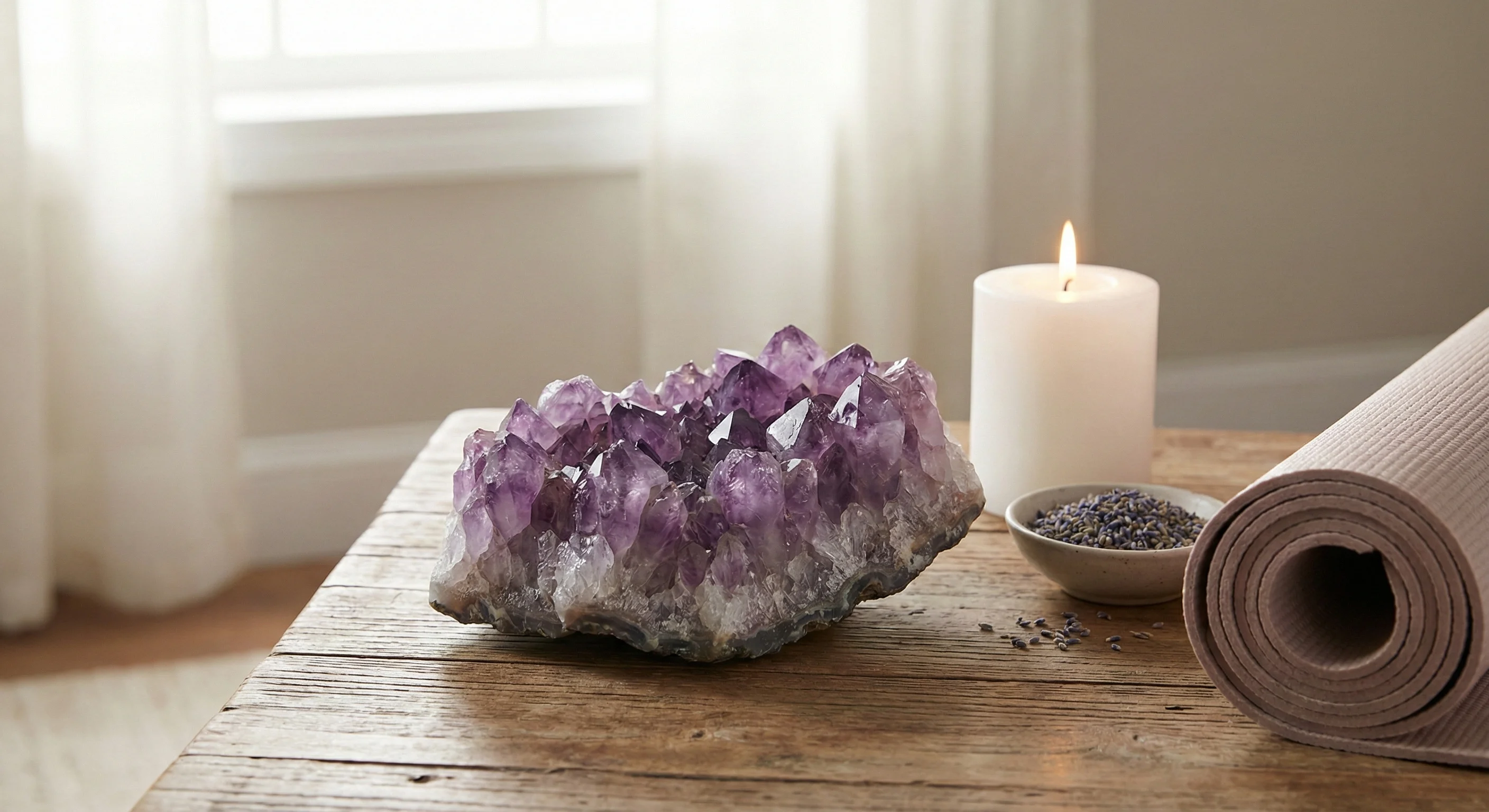
We need to strip away the pseudoscientific jargon that has long plagued the display of highly included quartz. Placing a large, hematite-rich amethyst geode in a studio corner isn’t casting a protective spell; it is executing a highly intentional act of spatial architecture. It is about mass, light interaction, and atmospheric gravity.

When I consult with interior designers on integrating geological specimens into high-end minimalist spaces, the conversation is strictly structural. A pure, gem-clear quartz point is visually hollow. It catches light but lacks density. It "floats" in a room. Conversely, an amethyst heavily occluded with black hematite plates and dense goethite clusters creates an immediate visual sinkhole. It absorbs attention. It provides a brutal, undeniable weight that grounds a room otherwise filled with airy fabrics and thin-profile modern furniture.

The "energy" people feel around these stones is profoundly real, but it is a psychological response to sensory stimuli, not a mystical emanation. Humans possess an innate, evolutionary response to sharp geometric contrast and deep, saturated color profiles (like the deep violet juxtaposed with metallic iron). We align our intentions with these objects because their physical permanence contrasts so sharply with our digital, ephemeral daily routines.

Consider the trade-off in spatial design. You cannot pack a room with heavily included stones without creating visual claustrophobia. They demand negative space. A 20-pound specimen of goethite-amethyst must be the undeniable focal point of a 400-square-foot room. If you clutter the area around it with lesser objects, you destroy the very atmosphere you are trying to cultivate. You must curate ruthlessly. Let the geological structure dictate the void surrounding it.
Authoritative References & Geological Literature

  • Mineralogical Society of America (MSA): Fluid Inclusions in Hydrothermal Environments. Review of microthermometry phase transitions and homogenization temperatures. minsocam.org
  • Gemological Institute of America (GIA): Spectroscopic Analysis of Iron Oxide Inclusions in Quartz. Defining the spectral distinction between Goethite, Hematite, and Lepidocrocite. gia.edu
  • US Geological Survey (USGS): Geochemistry of Amethyst Geodes in the Paraná Continental Magmatic Province. Understanding the genesis of high-inclusion silica deposits. usgs.gov
Sarah Whitmore
Principal Investigator

I’m Sarah Whitmore, a U.S.-based crystal practitioner and spiritual writer with a long-term focus on Amethyst, meditation, and intuitive awareness.

Amethyst Enthusiasts