Amethyst View
home / amethyst meaning metaphysical / Crown Chakra Awakening: Amethyst for Restful Nights & Holistic Space Design
Field Notes from 2026

The Physics of Sanctuary:
Anchoring the Mind with Amethyst

I've spent over a decade auditing high-stress sleeping environments. We don't reach for silicon dioxide clusters because of some mystical guarantee. We reach for them because in a world saturated by high-frequency biometric wearables and ambient blue light, a dense, cold, physical stone demands offline presence. Here is the unvarnished reality of setting up an energetic baseline for your evenings.

The Beta-Theta Friction Slowing the Mental Flywheel

A turbulent evening begins long before your head hits the pillow. It starts when the mind gets locked into a high-RPM Beta state. The friction you feel at 11:00 PM isn't a lack of tiredness; it's the sheer momentum of unresolved cognitive loops. You cannot brake a 30Hz brainwave pattern by simply closing your eyes. You need an interrupt.

The Tactile Interrupt

Amethyst acts as a passive, high-density anchor. Touching a cold, dense geological formation provides immediate somatosensory feedback, creating a micro-pause in the mental chatter. It’s an analog intervention in a digital loop.

The Synchronization Protocol

Staring at a screen won't lower your heart rate. Match your breathing to the visual expansion below to physically force a parasympathetic response.

Standby
Deep Dive: The Ugly Truth About "Vibrational Frequencies"

Let’s strip away the marketing jargon. A lot of modern wellness rhetoric treats crystals like they are active electronics. They are not. If you buy a massive Uruguayan amethyst expecting it to act like a noise-canceling headphone for your thoughts, you will be deeply disappointed.

The "frequency" we talk about in holistic circles is heavily reliant on neuro-association and intentionality. Amethyst is primarily silicon dioxide with iron impurities. Its crystal lattice is incredibly stable. When you introduce a stable, cold, physically heavy object into a chaotic environment—like your bedroom after a 12-hour workday—it serves as a psychological contrast point.

The Cost of Passivity

Here is the trade-off no one tells you: Amethyst is entirely passive. It demands your participation. I have audited bedrooms where clients scattered thousands of dollars of raw stones across their floor, yet they still scrolled through social media until 2 AM. The stones don't override your behavioral habits; they only amplify the space you create for them. If you refuse to put the phone in another room, the stone is just an expensive paperweight.

However, when you hold a tumbled piece of amethyst, feeling the smooth, cool surface absorb the heat from your anxious palm, you are anchoring your consciousness in the present physical reality. That tactile feedback is the actual bridge from Beta (anxious overthinking) to Theta (the threshold of rest). It is rudimentary biofeedback, and it takes deliberate practice.

Observing the Night's Topography

A common misconception is that a "good night" means eight hours of unbroken blackout. In reality, healthy rest has a complex architecture. Individuals who successfully integrate tactile anchors report less frustration during natural waking periods and a smoother return to deep rest.

Conceptual Depth Trajectory

Unanchored Baseline
Tactile Grounded
Deep Dive: Why Waking Up Isn't the Enemy

Look at the chart above. Notice that neither line is perfectly flat. Waking up briefly at 3 AM is an evolutionary feature, not a bug. The problem isn't the waking; it is the panic that ensues because you woke up. The mind immediately snaps into Beta: "How many hours left? I'm going to be exhausted tomorrow."

I advise my clients to stop fighting the awakening. This is where the bedside amethyst proves its worth. Instead of reaching for the phone to check the time—which hits your retinas with blue light and destroys your melatonin cascade—you reach for the stone on your nightstand.

You feel its weight. You trace its ridges. You focus entirely on the physical sensation of the stone in the dark. This shifts the brain's processing power from abstract anxiety (future-tripping about tomorrow's fatigue) to immediate sensory processing. It lowers the heart rate. Often, within ten minutes of this tactile focus, the user slips back down the gradient into REM or deep rest without ever checking the clock.

Field-Tested Protocols

These are not spells. They are structured behavioral habits supported by physical objects.

The Boundary Ritual

If you bring your laptop into bed, your brain associates the mattress with cortisol. We use the stone to draw a hard line.

  • The Physical Drop: Place a sizable piece of raw amethyst on the desk where you work. When you log off, intentionally cover it with a dark cloth. This physical act signals the end of the productive cycle.
  • Bedside Replacement: Pick up a smaller, tumbled stone for the nightstand. The smooth texture contrasts with the jagged raw stone, signaling the shift from sharp focus to smooth rest.

The Anchor Effect

When panic hits in the dark, you need something solid. The stone is a tangible reminder that you are physically safe in the room, regardless of where your thoughts are spiraling.
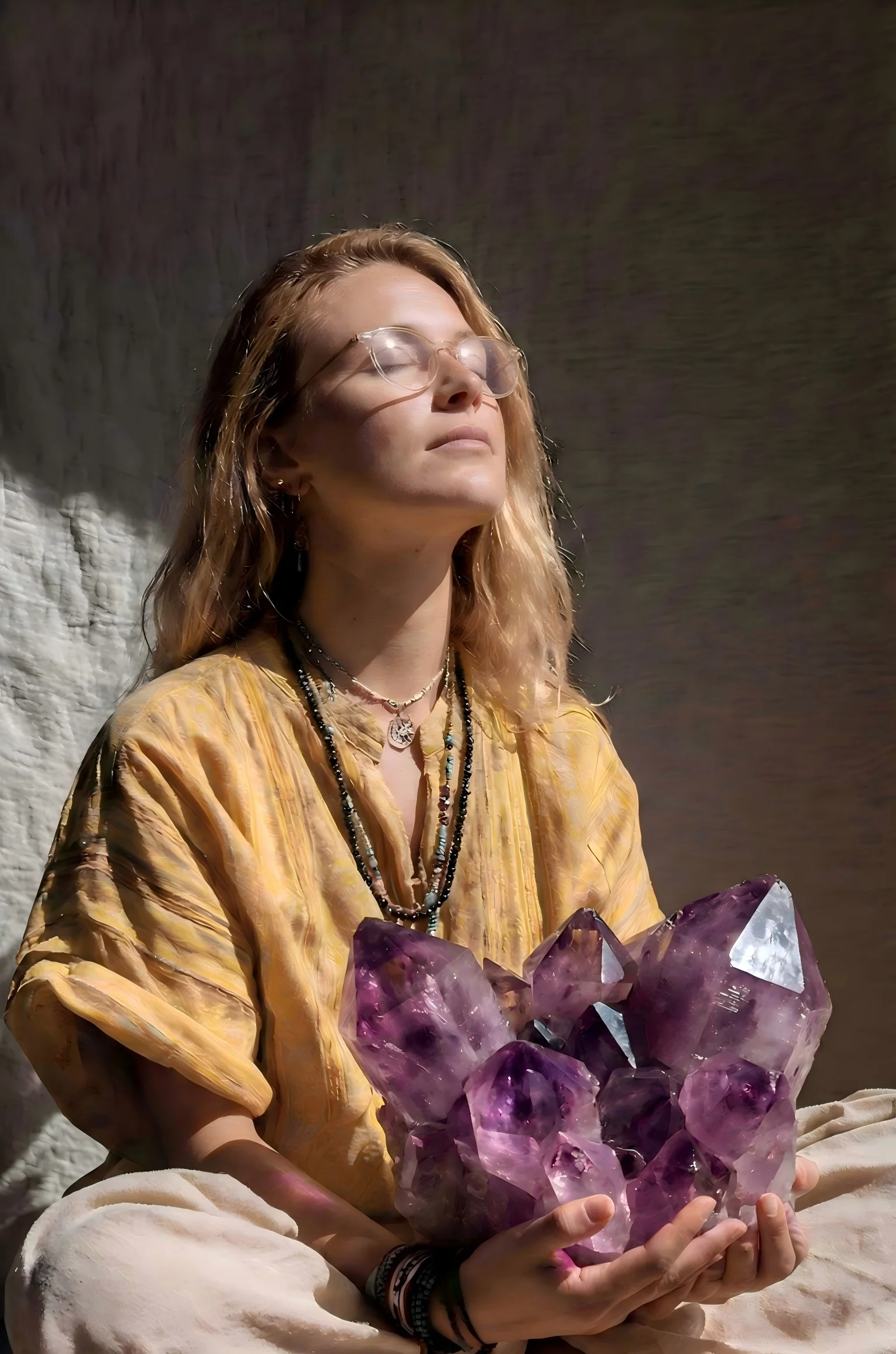
Deep Dive: The Cost of Hypnagogic Exploration

If you choose to use the "Hypnagogic Focus" protocols to enhance dream recall, you must understand the immediate physiological sacrifice: You will lose sleep quality in the short term.

Training the mind to remain slightly alert while the body descends into sleep paralysis requires breaking your natural cycle. The "Wake Back to Bed" method—waking up intentionally at 3 AM to meditate with the stone before returning to sleep—is highly effective for conscious dreaming, but it shatters your deep restorative phases for the first few weeks.

I have watched too many novices attempt this while working demanding 9-to-5 jobs. They end up exhausted, irritable, and resentful of the practice. If your primary goal is to wake up feeling rested, stay far away from dream-enhancement protocols. Use the "Evening Decompression" methods exclusively. You cannot optimize for deep, oblivious rest and highly alert, conscious dream states simultaneously. Pick your priority.

Spatial Architecture

Physical placement dictates interaction. Don't just decorate; engineer the space. Select an object below, then map its position.

1. Inventory Selection

🔮
Raw Amethyst Cathedral
Heavy, visually dominant, sharp.
🪨
Polished Palm Stone
Smooth, portable, tactile.
Black Tourmaline Chunk
Dense iron-rich boundary marker.

2. Room Grid Mapping

Far Corner
(Ambient)
Above Headboard
Nightstand
(Eye Level)
Window Sill
🛌
The Mattress
Work Desk
Near Door
(Entry)
Foot of Bed

Click placed objects to clear the zone.

Deep Dive: The Physics of Clutter and Scale

One of the most disastrous setups I frequently encounter is what I call the "Altar Overload." A client will place a 20-pound raw amethyst geode, several wands of selenite, and a bowl of tumbled stones on a tiny, fragile bedside table directly next to their head.

From a purely psychological and architectural standpoint, this is terrible design. A massive, heavy, sharp object looming over your skull while you are unconscious does not promote relaxation. The brain's primitive threat-detection systems remain subtly engaged. "Is that going to fall on me during a micro-tremor?" The aesthetic might look great on Instagram, but the spatial acoustics and physical density scream "danger."

Scale matters. Keep large, heavy "cathedral" geodes on the floor, in a sturdy corner, or near the door where they act as visual boundaries marking the transition from the outside world into the sanctuary. Keep the immediate perimeter of the bed visually clean. The only stone that should be within arm's reach is a small, polished piece that you can comfortably hold without fear of dropping a jagged rock on your face in the middle of the night.

The Reality Check

Energetic Friction & Discomfort

Introducing a new focal point into your space doesn't always feel good. Let's diagnose the friction rationally.

What is the primary point of friction?

Sarah Whitmore
Principal Investigator

I’m Sarah Whitmore, a U.S.-based crystal practitioner and spiritual writer with a long-term focus on Amethyst, meditation, and intuitive awareness.

Amethyst Enthusiasts