Amethyst Origin Guide:
Exploring Rarity & Character
Basalt flow thickness dictates value. From the thin-rind Artigas geodes of Uruguay to the hydrothermal "fingerprints" of Zambian Mwakambiko stones, geological provenance is the only metric that matters in 2026.
(Educational Tool Only - Not Financial Advice)
The Geode Cracker 🔨
Simulate the statistical improbability of finding gem-grade material. 90% of excavated tonnage is industrial gray quartz.
Sector A (Surface)
Weathered basalt. High oxidation risk.
Sector B (Basalt)
Standard flow. Variable silica content.
Sector C (Deep Vein)
Pressurized cooling. Potential "Royal" formation.
Deep Dive: The Geological Lottery of the Paraná Basin ▼
The randomness you experienced in the "Geode Cracker" is not merely a game mechanic; it is a direct representation of the Paraná-Etendeka Trap extraction process. The formation of collector-grade amethyst requires a "Goldilocks" scenario of geological events that occurred roughly 130 million years ago.
1. The Gas Bubble Hypothesis
Massive geodes begin as gas vesicles trapped within cooling basalt lava flows. If the lava cools too quickly (Sector A/Surface), the vesicles shatter or fail to form. If it cools too slowly, the silica remains fluid and never crystallizes. The "Deep Vein" success rate relies on the lava flow thickness—specifically, the middle zone where temperature gradients remain stable for millennia.
2. The Iron Irradiation Factor
Quartz (SiO2) is naturally colorless. The purple hue depends entirely on the presence of trace Iron (Fe3+) impurities replacing Silicon in the crystal lattice. However, iron alone is insufficient. The stone must undergo natural gamma irradiation from decay in the surrounding host rock to "activate" the color centers. This is why Artigas stones (rich in specific isotopes) develop that characteristic "ink-like" saturation, while Brazilian counterparts often remain a pale lilac.
Origin Characteristics
Select an Origin
Click on a region to understand its specific geological signature and 2026 collector appeal.
The 2026 Source Report: A Comparative Analysis ▼
Origin is not a branding exercise; it is a chemical fingerprint. In 2026, the market has bifurcated into two distinct categories: "Volume Goods" (Brazil) and "Specimen Goods" (Uruguay/Zambia). Understanding the tectonic differences is mandatory for any serious collector.
Artigas, Uruguay: The "Jelly" Effect
The basalt rind in Artigas is significantly thinner than in Brazil. This allowed for rapid cooling of the outer shell but sustained heat retention internally, creating small, concentrated cavities. The result is crystal growth with extremely high silica purity and intense iron concentration. Collectors call this the "Jelly" effect—a visual texture where the stone appears semi-liquid and gelatinous due to the lack of gray masking.
Mwakambiko, Zambia: The Siberian Echo
Zambian deposits are not geode-based but occur in veins within metamorphic rocks. This stressful geological environment introduces unique strain patterns in the crystal lattice. When cut correctly, these stones display distinct Pleochroism, flashing blue or red at different angles. This optical phenomenon mimics the extinct "Siberian" mines of the Urals, making Zambia the only modern source for "Siberian Grade" material.
The Color Grader 🎨
Can you match the "Siberian Grade"? Use the sliders to replicate the target color. Most collectors underestimate the saturation needed.
Target: "Siberian" Deep Purple
Your Mix
*Tip: Top-grade amethyst is often darker and more saturated than beginners expect. Look for the "Velvet" tone.
The Physics of "Velvet" Purple ▼
In your attempt to match the target color, you likely struggled with the balance between "Saturation" and "Lightness". This is the Extinction Paradox. As you increase saturation (adding more iron chromophores), the stone naturally absorbs more light, becoming darker (lower lightness).
The "Velvet" effect seen in top Artigas or old Siberian stones is physically caused by Red-Blue Dichroism combined with high saturation. The human eye perceives the mix of deep violet and flashes of red as a "velvety" texture. Commercial grade stones (Brazil) often suffer from "Color Zoning"—bands of clear quartz that dilute the saturation, making the stone appear washed out regardless of its hue.
- Hue: Ideally 275-280 degrees on the color wheel (Pure Violet, leaning slightly Blue, never Pink).
- Tone: 75-80% darkness. Anything lighter is "Commercial"; anything darker is "Onyx".
- Saturation: Vivid. The stone must hold its color even under fluorescent retail lighting, which typically washes out weaker amethyst.
The Mystery Loupe 🔍
Inclusions are nature's fingerprint. Move your cursor (the loupe) over the stone to reveal hidden internal features. Find all 3 to identify the origin.
Advanced Inclusions: Goethite vs. Lepidocrocite ▼
Using the loupe is not just about finding "spots"; it is about identifying specific mineral species. The red needles you found are often mislabeled as "cacoxenite" in amateur markets. In reality, they are almost exclusively Goethite or Lepidocrocite.
Why does this matter? Goethite needles (often forming fan-like shapes) are highly characteristic of the Artigas region in Uruguay. Finding them is a strong positive indicator of origin. Conversely, "Zebra Stripe" fractures—healed fissures containing liquid—are classic "Tiger Stripe" inclusions found in Zambian material.
Synthetic Alert: The "Breadcrumb" Test
Hydrothermal synthetic amethyst is lab-grown in autoclaves. It is often "too perfect". If you see irregular, "breadcrumb"-like inclusions, you are likely looking at un-melted feed material from the lab. Natural stones have fluid inclusions and crystal needles; labs have breadcrumbs.
Rarity Estimator
Estimate the collector rarity of a specimen based on 2026 historical data.
Estimated Rarity Score
Methodology: The Rarity Index Explained ▼
The calculation logic above is derived from the scarcity principle of the 2026 market. While clarity is king in diamonds, in colored gemstones like amethyst, Color is the dominant variable. A "Loupe Clean" pale lilac stone (Brazil) is geologically common and holds a Rarity Score below 20.
Conversely, a Zambian stone with moderate inclusions but "Deep Royal" color saturation commands a significantly higher score. Why? Because the geological conditions required to saturate quartz with that much iron often destroy the crystal's structural integrity. Finding a stone that is both saturated and clean is a statistical anomaly, hence the exponential jump in the score when you select "Deep Royal" + "Loupe Clean".
Deep Dive Library
GEOLOGY
Uruguay vs. Brazil: The Basalt Thickness Theory
▼
Uruguay vs. Brazil: The Basalt Thickness Theory
The fundamental difference between Artigas (Uruguay) and Rio Grande do Sul (Brazil) lies in the thickness of the Jurassic lava flows. Brazilian flows were massive, allowing for slow cooling and large geode formation with lower silica saturation. Uruguayan flows were thinner, cooling rapidly and trapping higher concentrations of trace elements.
This "Rapid Cooling Protocol" is what creates the smaller, darker geodes associated with Artigas. Collectors looking for 500kg "Cathedral" geodes will almost always be buying Brazilian material. Those seeking pocket-sized, jewelry-grade clusters with "Grape Jelly" color are hunting for Uruguayan basalt fragments.
IDENTIFICATION
The "Hourglass" Phantom of Morocco
▼
The "Hourglass" Phantom of Morocco
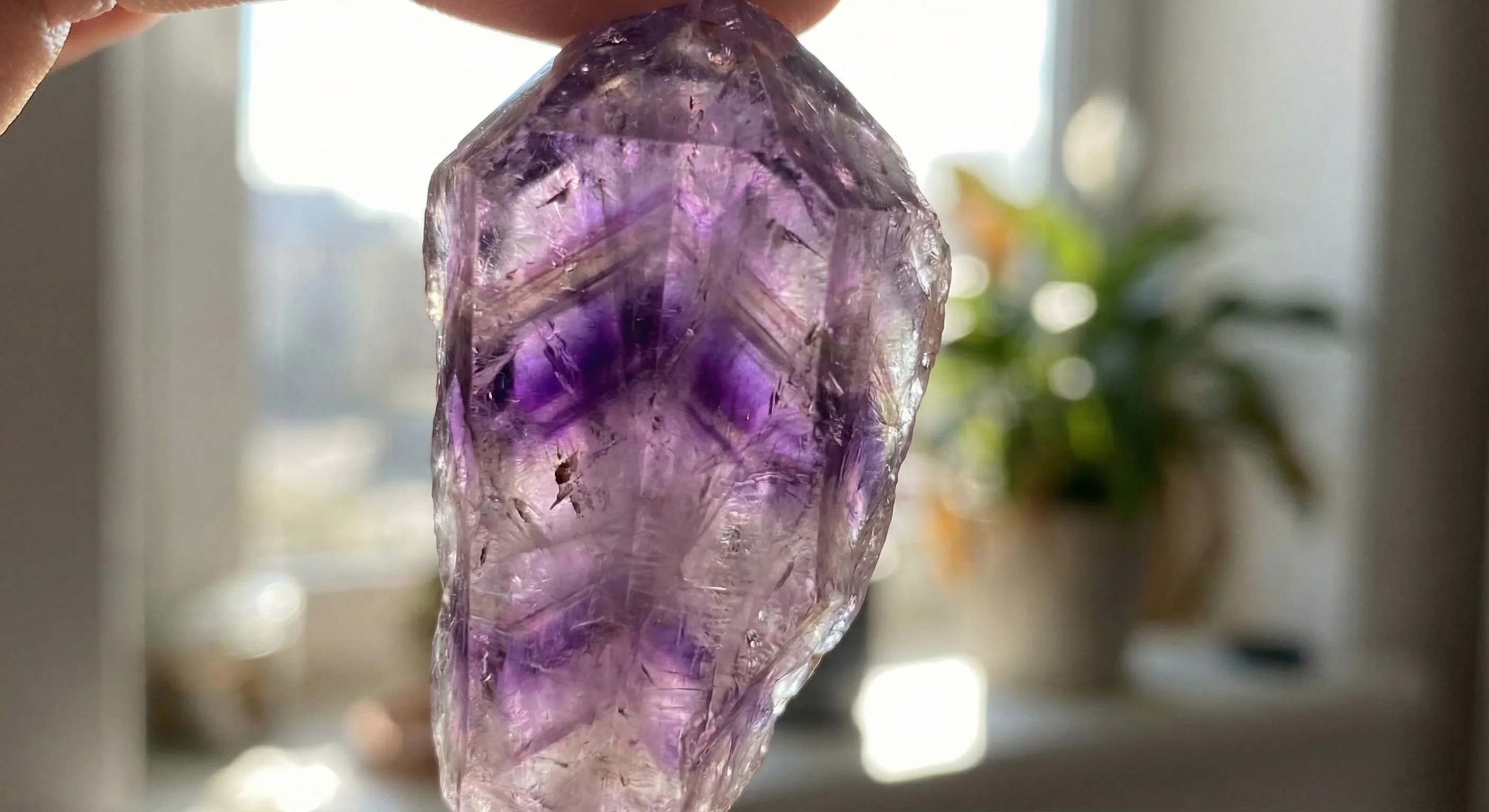
Amethyst from the Boudi region of Morocco is unique. It rarely forms in geodes. Instead, it forms in hydrothermal fissures, allowing the crystals to grow "Double Terminated" (points on both ends). The key collector feature is the "Hourglass" phantom—a distinct purple zoning pattern that looks like an hourglass inside the clear crystal.
This is caused by selective absorption of iron on specific crystal faces (r-faces vs z-faces) during growth spurts. It is a timeline of the crystal's life, frozen in purple.
MARKET HISTORY
The 2026 "Flash" Demand
▼
The 2026 "Flash" Demand
Historical analysis of demand shows a shift away from "Perfect Clarity" toward "Character". The Zambian "Blue Flash"—a result of pleochroism in high-iron quartz—was considered a defect in the 1990s. Today, it is the primary value driver for the Asian market. Collectors are now prioritizing unique optical phenomena over standardized GIA clarity grades.