Curatorial Protocol
Amethyst Geodes & Raw Specimens:
The Aesthetic Reality
Uncrating a 200kg cathedral geode is rarely a pristine experience. The wooden shipping crates smell heavily of damp eucalyptus from the Artigas supply lines, and the rough basalt rind will easily tear through heavy leather gloves. We evaluate Amethyst cluster value not by sheer tonnage, but through a brutal inspection of crystallographic integrity, microscopic inclusions, and physical vulnerabilities.
Collector Interest Index (2020-2026)
Tracking historical global gallery acquisitions for high-end specimens versus standard decorative grades. The aesthetic divide is widening.
The Ugly Truth: Tonnage vs. Transparency ↓
I have inspected hundreds of shipping containers arriving from Rio Grande do Sul and Northern Uruguay. The chart above implies a clean, upward trajectory for "museum grades," but the physical reality on the loading dock is far more complex. Stop buying based on physical height alone. A three-meter tall geode is utterly meaningless if the quartz points lack optical clarity.
Here is the friction point dealers rarely discuss: Structural stabilization. Massive geodes are almost never extracted completely intact. The basalt host rock fractures easily during the pneumatic drilling process. To keep a 500kg specimen standing upright, extraction teams pump the base and rear fissures full of heavily dyed, industrial-grade epoxy and cement.
When you acquire an Amethyst Geode Price baseline, you must calculate the "dead weight." I've seen novice collectors pay premium per-kilo rates for pieces that were comprised of 35% painted concrete by weight. We demand ultrasonic thickness gauging on the basalt rind. If the matrix isn't authentic, the structural integrity of the entire display is compromised over decades. The trade-off is stark: demand absolute natural integrity, and you must accept smaller, less symmetrical formations. Perfect symmetry at a massive scale is almost always engineered by human hands.
Aesthetic Anatomy Simulator
Adjust the morphological variables below. Observe how specific geological anomalies—like Goethite inclusions and deep Uruguayan geode saturation profiles—alter the specimen's curatorial score.
Curatorial Score
1,500
Standard Specimen
The Geology of "Flaws": Decoding Inclusions and Saturation ↓
Twenty years ago, the traditional gem market demanded flawless, glass-like quartz. Anything containing foreign minerals was heavily discounted. Today, the criteria for Museum quality minerals has inverted. We actively hunt for what commercial buyers mistakenly call "flaws."
When you toggle the "Goethite" checkbox in the simulator above, you are adding golden-brown, broom-like tufts of iron oxide to the internal lattice of the quartz. Physically, these needles form prior to or concurrently with the silica crystallization in the hydrothermal cavity. They are microscopic time capsules. The visual impact is striking—golden flares trapped within deep violet ice. However, the trade-off is absolute: heavily included stones scatter light differently. You sacrifice the pure, unadulterated "glassy" bounce of a clean crystal for a complex, terrestrial landscape. It requires specific, directional spotlighting to truly appreciate, otherwise, the geode simply looks dusty from a distance.
Furthermore, the pursuit of the "Velvet Black-Purple" (often dubbed the Siberian color standard, despite originating mostly from Artigas, Uruguay) presents a severe limitation. The heaviest concentrations of iron impurities (which cause the purple coloration) inherently stunt the macroscopic growth of the individual crystal points. It is a fundamental law of these specific geological formations: you can easily find massive, fist-sized crystal points in pale, washed-out Brazilian lavender geodes. But if you demand the darkest, most light-absorbent purple, you must usually accept much smaller, tightly packed crystal drusy. Stop searching for soccer-ball-sized points in velvet black; they practically do not exist outside of highly anomalous, individual museum captures.
The Microscopic & Photonic Lab
Evaluating optical performance requires looking closer. We must identify synthetic anomalies under 10x magnification and understand the brutal realities of photonic degradation.
1. Forensic Optics
Hover the reticle over the plates to simulate a 10x jeweler's loupe. Identify the growth structures.
Hydrothermal Origin
Lab-Grown Glass
2. Photonic Degradation
Simulate the destruction of Fe4+ color centers under ultraviolet radiation. Drag the exposure slider.
Vault Storage
Stable Fe4+ Core
Direct Sunlight
The Physics of Ruin: Why Beautiful Stones Die ↓
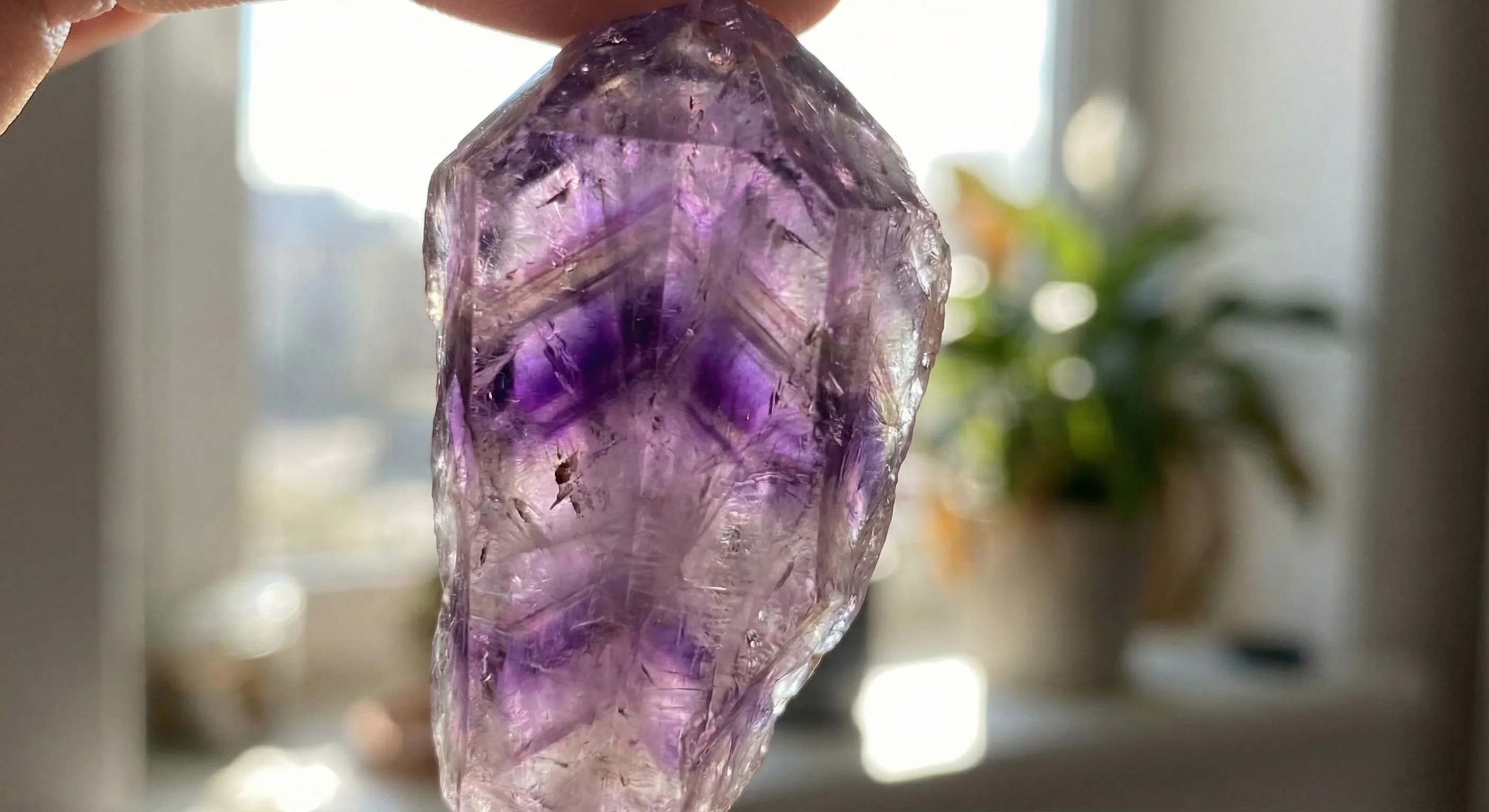
We need to talk about the physical reality of quartz matrices. When examining raw amethyst under magnification, true natural stones exhibit distinct color zoning—sharp geometric angles of deep violet alternating with almost clear quartz. This is a record of the shifting iron concentrations in the water during millions of years of growth. Synthetics, conversely, look like stagnant pools of uniform dye, often peppered with perfectly spherical gas bubbles trapped during rapid cooling.
But the most heartbreaking conversations I have with collectors involve the UV slider demonstrated above. The deep purple of amethyst is not a stable pigment. It is a color center defect created when iron impurities (Fe) in the quartz lattice are exposed to natural gamma radiation over geological timescales, causing an electron to be ejected and creating an Fe4+ state. This state absorbs certain wavelengths of light, transmitting purple to our eyes.
Here is the reality check: Ultraviolet light acts as an electron reset. When photons from direct sunlight hit the crystal lattice, they provide the exact energy needed for the electrons to drop back into their original state. The iron remains, but the color vanishes. This process is cumulative, completely silent, and totally irreversible without re-irradiating the stone in a nuclear reactor. I have personally witnessed a collector's masterpiece—a highly saturated Uruguayan cave—reduced to a washed-out, pale grey husk because they insisted on placing it in a south-facing atrium for three years. If you cannot provide a light-controlled environment, do not acquire museum-grade amethyst.
Spatial Diagnostics
Curating a large specimen in a living or working space requires rigorous logistical planning. We utilize the grid below to run diagnostics on physical load, foot traffic, and UV exposure paths to create secure visual anchors.
Diagnostic Tool:
Select a zone on the floor plan to evaluate the environmental and structural viability for a 150kg installation.
"Awaiting spatial sector selection for analysis..."
☼ South Elevation (High Lumen) ☼
⎋ Primary Transit Path
Static Millwork
The Logistics of Weight and Dust ↓
Moving beyond the aesthetic ambiance, the physical integration of a raw geode is an engineering challenge. The sandbox above maps out light and traffic, but it ignores the brutal reality of gravity. A standard cathedral geode weighs roughly 150 kilograms (over 330 pounds) and focuses that immense mass onto a very small, uneven basalt footprint. Placing this directly on standard residential hardwood floors is a guaranteed failure. You will crush the subfloor and permanently dent the finish. They require custom-welded steel bases designed to distribute the point-load pressure across a wider surface area.
Then comes the maintenance. A deep geode cavity filled with hundreds of jagged, unpolished quartz points is a perfect static trap for airborne particulate matter. They are absolute dust magnets. In a standard home environment, a deep purple crystal will begin to look dull and greyish within four weeks due to micro-dust settling in the crevices. You cannot simply wipe them down with a cloth—the sharp edges will shred the fabric and leave lint snagged on every point.
The operational reality? We maintain these installations using compressed air canisters designed for electronics, coupled with soft-bristled drafting brushes. If grease or humidity binds the dust to the crystals, the cleaning protocol requires a controlled spray of distilled water and isopropyl alcohol, catching the runoff at the base. It is a tedious, hands-on commitment. If you are not prepared for the physical labor of maintaining the visual clarity, stick to small, polished display pieces enclosed in glass cabinetry.
Academic & Authority References
-
■
Gemological Institute of America (GIA).
"Color Centers and Irradiation in Natural Quartz." Gemological Research Journal, 2024. -
■
Hudson Institute of Mineralogy / Mindat.org.
"Amethyst: Mineral information, data, and localities." Comprehensive database on Artigas formation structures. -
■
RRUFF Project.
"Raman Spectra Analysis of Inclusions in Macrocrystalline Quartz." Department of Geosciences, University of Arizona.
Principal Investigator
Sarah Whitmore
I’m Sarah Whitmore, a U.S.-based crystal practitioner and spiritual writer with a long-term focus on Amethyst, meditation, and intuitive awareness.
Amethyst Enthusiasts