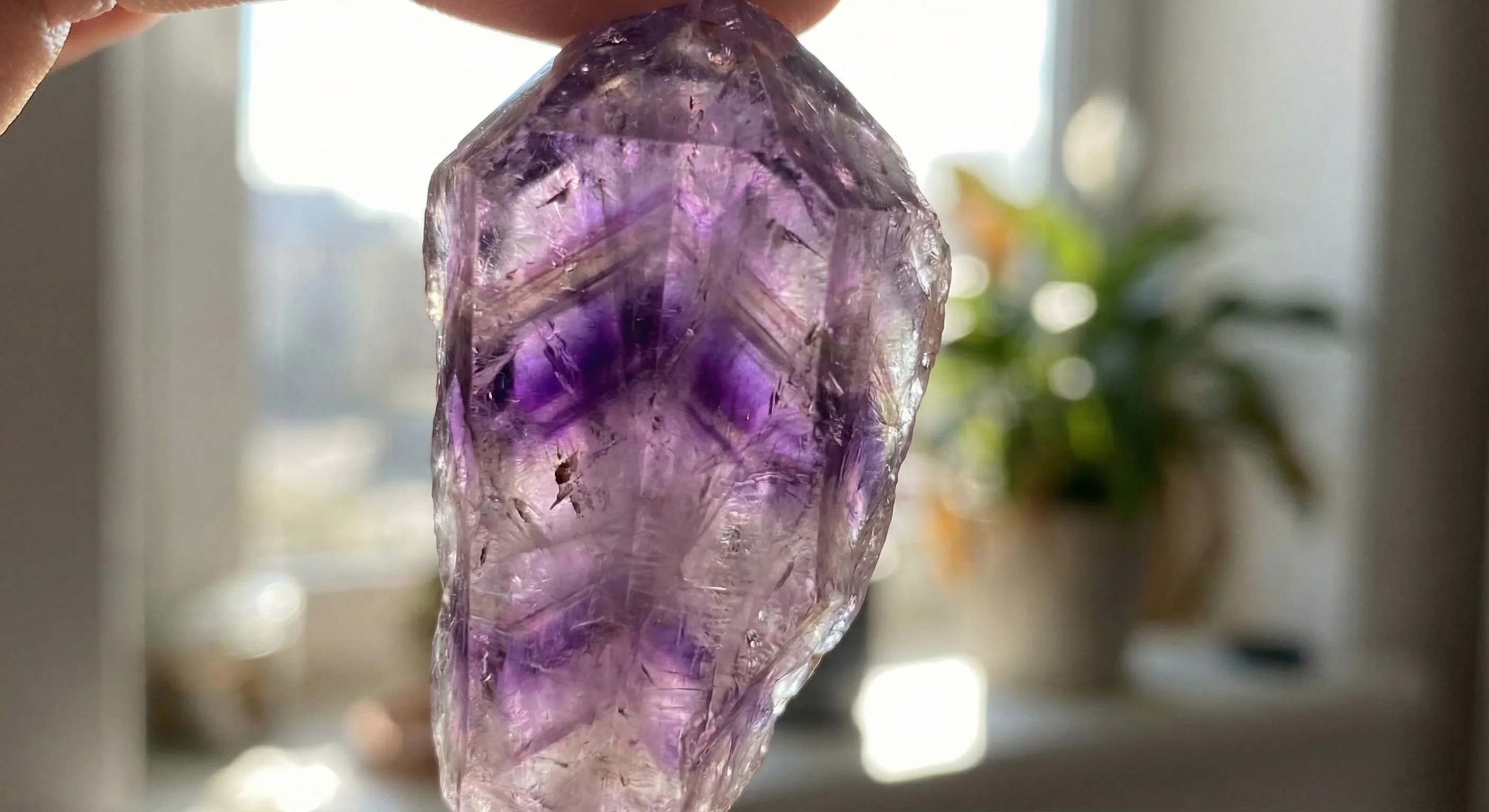
🔍 Microscopic Inclusion Explorer
Select a material category. Hover over the canvas to simulate a 10x jeweler's loupe inspection.
Natural Amethyst: Look for "tiger stripes", liquid inclusions, and color zoning patterns.
Stop relying on smartphone identification apps. They fail consistently on hydrothermal synthetics. Welcome to the physical reality of desktop gemology. Distinguishing earth-mined quartz from laboratory-grown specimens and industrial glass requires tactile, optical, and structural verification.
"The friction point in modern mineralogy isn't identifying obvious glass. It's navigating the ambiguous gray area where a six-week laboratory autoclave cycle perfectly mimics millions of years of geothermal pressure."
Forget pristine textbook examples. Real specimens are messy, heavily included, and visually ambiguous.
Select a material category. Hover over the canvas to simulate a 10x jeweler's loupe inspection.
Slide the polarizer to observe Brazil Law twinning. This optical interference confirms crystalline lattice growth.
I have spent thousands of hours hunched over gemological microscopes and immersion cells. The romanticized idea of identifying a natural amethyst with a quick, confident glance through a loupe is a persistent myth perpetuated by social media experts. When you actually perform these optical tests, the physical reality is entirely different. Let’s discuss the genuine friction involved in desktop gemology.
When you drop a suspected amethyst specimen into a glass cell filled with benzyl benzoate—a highly refractive, sticky immersion fluid that smells faintly and unpleasantly of medicinal almonds—and cross the polarizing filters, your eyes immediately strain against the darkness. You are searching for Brewster fringes, those elusive, zebra-striped interference patterns that indicate Brazil Law twinning. In textbook diagrams, they look like neat, black triangles. In a raw, unpolished, or heavily included stone, the internal fractures scatter the polarized light in chaotic directions, making it nearly impossible to isolate the c-axis.
The ugly truth about the polariscope is that nearly 30% of the time, even a seasoned practitioner has to rotate the specimen in the fluid until their fingers cramp, only to concede the test is inconclusive. You are constantly balancing the trade-off between the speed of visual inspection and the absolute certainty of structural analysis. Furthermore, modern hydrothermal synthetic quartz is occasionally grown on twinned natural seed plates. I have seen laboratory-grown amethyst that mimics the optical twinning of natural stones just enough to cast doubt on a standard polariscope reading. Stop treating visual optics as an infallible absolute; start treating them as one layer in a deeply complex filtering process.
Regarding the loupe: pressing a cold metal 10x triplet against your orbital bone and staring into a brightly lit stone induces eye fatigue within minutes. You are not looking for perfection; you are hunting for specific types of flaws. Natural fluid inclusions—often called "tiger stripes" or "zebra stripes"—are three-dimensional negative crystals filled with trapped primordial water and sometimes a tiny gas bubble. Conversely, the "breadcrumb" inclusions found in hydrothermal synthetics are un-melted clusters of the silica feed material. They look dry, opaque, and granular. Distinguishing between a natural solid inclusion (like a goethite needle) and a synthetic nail-head spicule requires an understanding of how materials crystalize under stress. It is a deeply tactile, exhausting, and subjective process.
Destructive testing is a harsh reality. The Mohs scale measures scratch resistance. A harder material permanently displaces the surface of a softer one.
There is a massive disconnect between theoretical gemology and handling someone's prized collection. In theory, the Mohs hardness test is a definitive, simple diagnostic tool. Quartz sits at 7; standard manufactured glass sits around 5.5. Therefore, a steel file (6.5) will effortlessly bite into glass while sliding harmlessly across quartz. In reality, destructive testing is a high-stress gamble that I employ only as an absolute last resort.
I once watched an amateur enthusiastically drag a hardened steel pick across the termination of a stunning, deep-purple Uruguayan cluster to "prove" it was real. While the steel did not scratch the quartz lattice, the immense localized pressure shattered the brittle tip of the crystal, instantly vaporizing significant collection value. The trade-off with Mohs testing is absolute material confirmation versus irreversible physical damage. If you must perform a scratch test, you do it on the bottom matrix or a heavily abraded edge—never on a display face.
Furthermore, interpreting the physical feedback requires sensory experience. When a steel tool strikes quartz, it often leaves a silvery, metallic streak. To the untrained eye, this streak looks exactly like a scratch. You have to take a damp cloth and firmly wipe the area; if the mark disappears, the tool left material behind. If the line remains, the lattice was breached. Stop attempting hardness tests without understanding the difference between a material streak and a structural fracture. The tactile feedback is crucial: glass feels soft and yields smoothly under the steel point, generating a fine white powder. Quartz feels violently resistant, causing the steel tool to skip and chatter across the surface.
This logic flow demonstrates how professionals deduce a material's origin by filtering out optical and physical anomalies.
Are there visually perfect, spherical bubbles trapped inside?
The logic tree above is your frontline defense. It efficiently filters out 90% of the manufactured glass and low-effort synthetics flooding the market. However, any expert must acknowledge the limitations of their tools. The friction point in 2026 isn't identifying glass; it is identifying the output of a meticulously calibrated, six-week hydrothermal autoclave cycle originating from advanced industrial labs.
Let's discuss the "thermal touch test," a favorite among traditional collectors. When you press a natural amethyst to your upper lip—the most temperature-sensitive area of your face—it pulls heat away instantly due to quartz's high thermal inertia. Glass feels stagnant and warms to skin temperature almost immediately. It is a highly satisfying, physical test. The problem? Hydrothermal synthetic quartz is structurally identical to natural quartz. It possesses the exact same thermal conductivity. Therefore, the touch test only eliminates glass; it does absolutely nothing to protect you from lab-grown synthetics. Stop relying on temperature to confirm natural origin.
The most terrifying specimens I examine are intentionally doped synthetics. Manufacturers know that gemologists look for flawless clarity as a sign of synthetic origin. In response, some laboratories now manipulate the growth environment to induce artificial fluid inclusions and irregular color zoning. I recently evaluated a massive, 50-carat "Uruguayan" facet rough. It had bands of alternating purple. It felt perfectly cold to the touch. Under a 10x loupe, I spotted what looked like genuine liquid-filled negative crystals. It bypassed every desktop metric we possess.
It was only when I placed the specimen inside a $150,000 FTIR (Fourier-Transform Infrared) spectrometer that the truth emerged. The machine detected a sharp water absorption band at 3595 cm^-1, a molecular signature completely absent in natural earth-mined amethyst, betraying its rapid growth in an alkaline laboratory solution. The trade-off of relying solely on accessible, visual diagnostic tools is accepting a margin of error. When evaluating high-value pieces, you must accept that absolute certainty cannot be achieved on a kitchen table; it requires advanced spectrophotometry.
Evaluate the structural traits. Is the description indicative of Natural Quartz or Manufactured Material?
Structurally amorphous materials, often sold under various trade names, require specific identification parameters completely distinct from crystalline minerals.
Spherical Gas Bubbles: The absolute definitive trait. As molten silica cools rapidly in an industrial setting, ambient air is trapped forming perfect geometric spheres. This is physically impossible within the slow, pressurized growth of natural crystal lattices.
Flow Lines (Swirls): Highly viscous liquids mixed dynamically during manufacturing leave visible flow marks or distinct color swirls, similar to stirring syrup into water.
Isotropic Optics: Glass lacks an internal geometric structure. It is singly refractive. It will never exhibit pleochroism (color shifting based on angle) or structural twinning under a polariscope.
*Educational distribution model showing standard categorization of transparent purple materials encountered in general commerce outside of certified gem dealers.
Let's strip away the marketing terminology and examine the physical reality of brightly colored, transparent chunks sold widely across internet marketplaces. The geological term is amorphous silica; the industrial term is cullet. I have personally toured massive landscaping supply yards where this exact material is sold by the ton, intended to be used as decorative filler in gas fire pits or architectural gabion walls.
Handling raw, unpolished slag glass is an unforgiving tactile experience. The material breaks with extreme conchoidal fractures, resulting in curved, razor-sharp edges resembling broken bottle bottoms. I have spent days picking microscopic, transparent glass splinters out of the pads of my fingers after evaluating a client's collection of these materials. Natural quartz also exhibits conchoidal fracturing, but it rarely produces the aggressively sharp, fragile, peeling edges found on mass-produced glass chunks.
Another physical anchor is specific gravity (density). When you pick up a substantial piece of manufactured glass, your brain registers an anomaly. It feels noticeably lighter than a similarly sized piece of solid quartz. The specific gravity of standard glass hovers around 2.4 to 2.5, whereas quartz sits rigidly at 2.65. While a margin of 0.15 seems trivial on paper, in the hand of someone who has handled thousands of minerals, it feels fundamentally wrong. It lacks the dense, heavy presence of earth-mined stone.
However, the most frustrating aspect of evaluating this material isn't the physical testing; it is the psychological barrier. When a user has committed significant resources—both time and capital—into the narrative surrounding a piece of brightly colored glass, providing scientific data often causes friction. Demonstrating the presence of perfectly spherical, trapped air bubbles under a microscope rarely alters their perspective. You cannot out-science an emotional purchase. As geologists and educators, our role is simply to provide the structural facts: it is an isotropic, amorphous solid created through rapid thermal cooling. What atmosphere or focus the user derives from the object is entirely their own prerogative.
I’m Sarah Whitmore, a U.S.-based crystal practitioner and spiritual writer with a long-term focus on Amethyst, meditation, and intuitive awareness.